Search Travelogueress

Showing posts with label South America. Show all posts

Tuesday, 23 August 2011

Argentina The End – The Last Tango


Date: 29 December 2010
Day: Wednesday
Location: Buenos Aires
Scribble:
-         Tomorrow, we will go back to London via Sao Paolo. We will wait in Sao Paolo for 3 hours. I hope that we will be allowed to leave the plane during this time. It is going to be a very long flight!
The reason why Buenos Aires doesn’t look like other colonial Spanish cities is because from the end of the 19th century until 1930s when Argentina was the 5th richest country in the world, the city passed through the hands of famous architects so that it could be as grand and famous as cities like Paris, Madrid and Rome.

Even though Argentina is a Spanish colony, most of the immigrants came here from Italy, then from Spain. Germans are the third in line. Argentina has the largest Irish population in all the Spanish colonies. Che, the Argentine icon, whose full name was Ernesto “Che” Guevara de Lynch was of Irish decent.

Even though the Argentines mainly have Latin blood and DNA, especially the infrastructure of Buenos Aires, its ports and railways have been constructed by English firms and immigrants. Famous and rich neighbourhoods like Palermo have been designed by the French architect Charles Te. 
Including the suburbs, the population of the city is 12 million (Argentina is 40 million). It is the most crowded city with the worst traffic in South America after Sao Paolo.
Actually, now we are glad that we spent more time in Patagonia and saw the Argentine nature because there is really no need to spend more than 2 days in Buenos Aires. In a way, it is the Americanised version of Paris.

Undoubtedly, the pink presidential palace where Juan and Eva Peron used to appear from the balcony (now it is the president’s office), the San Telmo neighbourhood, which suffered from the cholera and yellow fever outbreaks so the wealthy families left it for Recoletta and most important of all La Boca have elements of their own and contain the Argentine culture.
Buenos Aires’ river Rio Plata is the second widest river in the world (it can reach up to 250 km).

It is clear that they see Maradona almost like a god. 
Maradona is everywhere and almost is a tourist trap. 
The Boca Stadium where Maradona used to play is considered as one the important monuments of Buenos Aires.
The La Boca neighbourhood is a shantytown built by the old port. 
It never lost its shantytown status since its first days. The Italian immigrants who had absolutely nothing settled here and built themselves houses with whatever they could find (i.e. tin). Then, they painted these tins.
So the colourful La Boca is not actually an immigrant Disneyland
The buildings are really made of tin and they really are colourful. 
It is far from the city’s noise and traffic. The best Buenos Aires air can be felt here with tango music and dance in every corner.
Due to security problems, it is only advisable to visit here during day time and only to walk on the main street. 
Unfortunately, like everywhere in the world, there are all kinds of ways to get money from the tourists.
As we wanted to have a light lunch, we snacked on a few empanadas here (incredibly delicious) but then when we learnt that the restaurant didn’t accept credit cards and we didn’t have any cash, I had to wait at the restaurant and F. had to withdraw money from the ATM of Banco Nacion. 
As he took a long time to come back, I had to share the table with a group from Israel and I even gave them advice on what to choose from the menu.
Even though the area to go around safely in La Boca is quite limited, it is easy to spend hours here.
The Argentines are very fond of dulce de leche (milk jam) and add it in everything. If it were possible, they would even add it on steak as sauce. However, we preferred to taste dulche de leche ice cream across the Recoletta Cemetary. It was like caramel ice cream.

However, the real issue is that at the ice cream parlour, we realised that the 100 pesos that F. withdrew from the ATM earlier was fake. We were told that there was absolutely nothing we could do about it! It seems like fake money is a major problem is South America. Then we researched and learnt that this is a major problem that the tourists face especially with 50 and 100 peso notes even if the money is withdrawn from the ATMs of banks such as Citibank and HSBC. Banks don’t accept responsibility and claim that the machines destroy the fake money but it is not true! Before going to Argentina or Peru, you must somehow exchange the money in your country or don’t even trust the ATMs, exchange your money face to face inside the bank. There is no other way. This is a big problem in South America and most tourists suffer from it. Otherwise, you could insist on paying in dollars as even the taxis usually accept American dollars.

Eva Peron’s tomb, in fact, her mausoleum is in the Recoletta Cemetery under the name of her family, Duarte
She is not buried in her husband’s mausoleum but with her family.
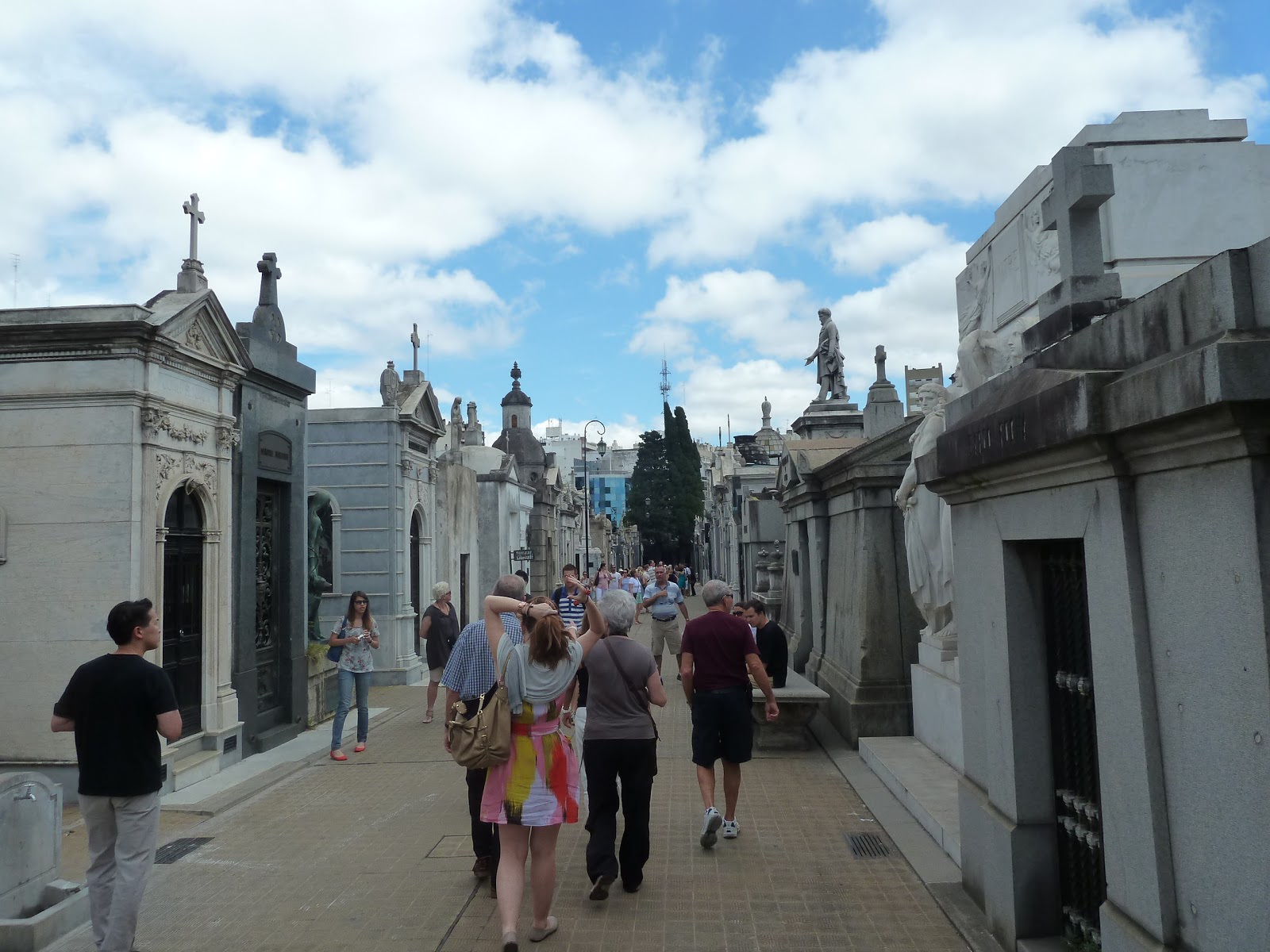
What’s interesting is that this cemetery is like a city in itself. 
It has streets and each mausoleum is like a building or a temple.
In each mausoleum, at least two families, especially the many homeless of Buenos Aires could live easily. 
It was shocking. 
The cemetery of the wealthy who care about status even after death…
 
We spent our last night in Buenos Aires and South America by dining in San Telmo at the El Viejo Almacen restaurant and watching a tango show at the cabaret with the same name and which is considered a tango temple. This was a nice and appropriate ending to our South America trip.
What I noticed the most at dinner was the sauce they served with bread. It was exactly like the Turkish hot “ezme” but with olive and oregano added to it. It was finger licking delicious.

I would have loved to have danced samba in Brazil and tango in Argentina during our South America trip but alas, there was no such opportunity. 
Nevertheless, tonight’s tango show gave me goose bumps at times with the acrobatic movements.
I loved South America and I will miss places like Rio, Patagonia and La Boca. Even though we have been away from home, London for a long time, we don’t feel tired or miss our home. Besides Aguas Calientes in Peru, we felt at home everywhere and comfortable.
I cannot stop myself from thinking again that I am so lucky to have seen these places and that my wishes have come true. That’s why I even feel a little guilty. I always think that there must be a reason. Perhaps, my sole responsibility is to live the life that the Creator gave me.
All photos & videos, Copyright Travelogueress

Thursday, 18 August 2011

Argentina Part VI – Buenos Aires


Date: 28 December 2010
Day: Tuesday
Location: Buenos Aires
Scribble:
-          Today, we learnt that Buenos Aires is the world’s 4th noisiest city.

On our last morning in El Calafate, we woke up to a perfect sunny weather and blue sky. It was neither too hot nor too cold. It was perfect. To take advantage of the weather, we took one last stroll in this town full with cute and modest houses and very old model cars (this includes my grandfather’s Renault V). I will miss El Calafate and Patagonia. I don’t think I would ever be able to come back here due to distance and the price but if I had the opportunity, I would love go horse riding on the Patagonian steppes. In fact, after spending time in so many big and crowded cities, it was good and relaxing for us to spend time in this quiet and calm town.

After reaching Buenos Aires in the afternoon, we again found ourselves in a different climate, in the 35 degree heat. We walked around the city for three and half hours, especially around the Recoletta neighborhood (equivalent of Nisantasi in Istanbul), which is close to our hotel Las Americas 
and the elegant Puerto Madero by the river.
No wonder Buenos Aires is called the Paris of the Americas continent. It really is. 
In parts, it is cleaner than Paris and in parts, it is dirtier and chaotic. 
It is a version of Paris with wider avenues and modern buildings.
We had a small break in Recoletta and had empanada in a restaurant called Cumana. Anything you wish can be added in an empanada: meat, fish, chicken, vegetables, cheese etc. It was very tasty and it was a good choice to go somewhere where the locals hang out but I cannot say that the decoration and service were as good as the empanadas.
We had our dinner at a restaurant called Happening in Puerto Madero. Tomorrow, we will complete our tour around the entire city and then say goodbye to South America.
All photos, Copyright Travelogueress

Friday, 12 August 2011

Argentina Part V

Date: 27 December 2010
Day: Monday
Location: El Calafate
Unfortunately, we fell victim to one of the tourist traps today. Our intention was to see the other big and important Patagonian glaciers from the Argentina Lake, which has a surface of 1560 square km. However, the ship we got on was a 200 people tourist trap.
It was a comfortable way to see the glaciers for people who spend little time here, who are lazy to trek through the forest and on the glacier and who are retired.

F. and I thought that thank goodness we had the real experience yesterday. The views we saw from the ship were most certainly magnificent but it is still very different than being there. We saw massive icebergs on the lake, which only display 15% of their mass above the water.
We could see the biggest glacier of Patagonia, the Upsala Glacier which is 860 square km wide only from the distance because the captain did not think that it was safe enough to sail through the canal, which was filled with icebergs.
On our way to Argentina’s highest glacier, the Spegazzi Glacier, we could see some dried and receded glaciers and the effects of climate change with our own eyes. 
The glaciers leave a very empty space where they dry. There is no life. In addition, they cause water levels to rise up.
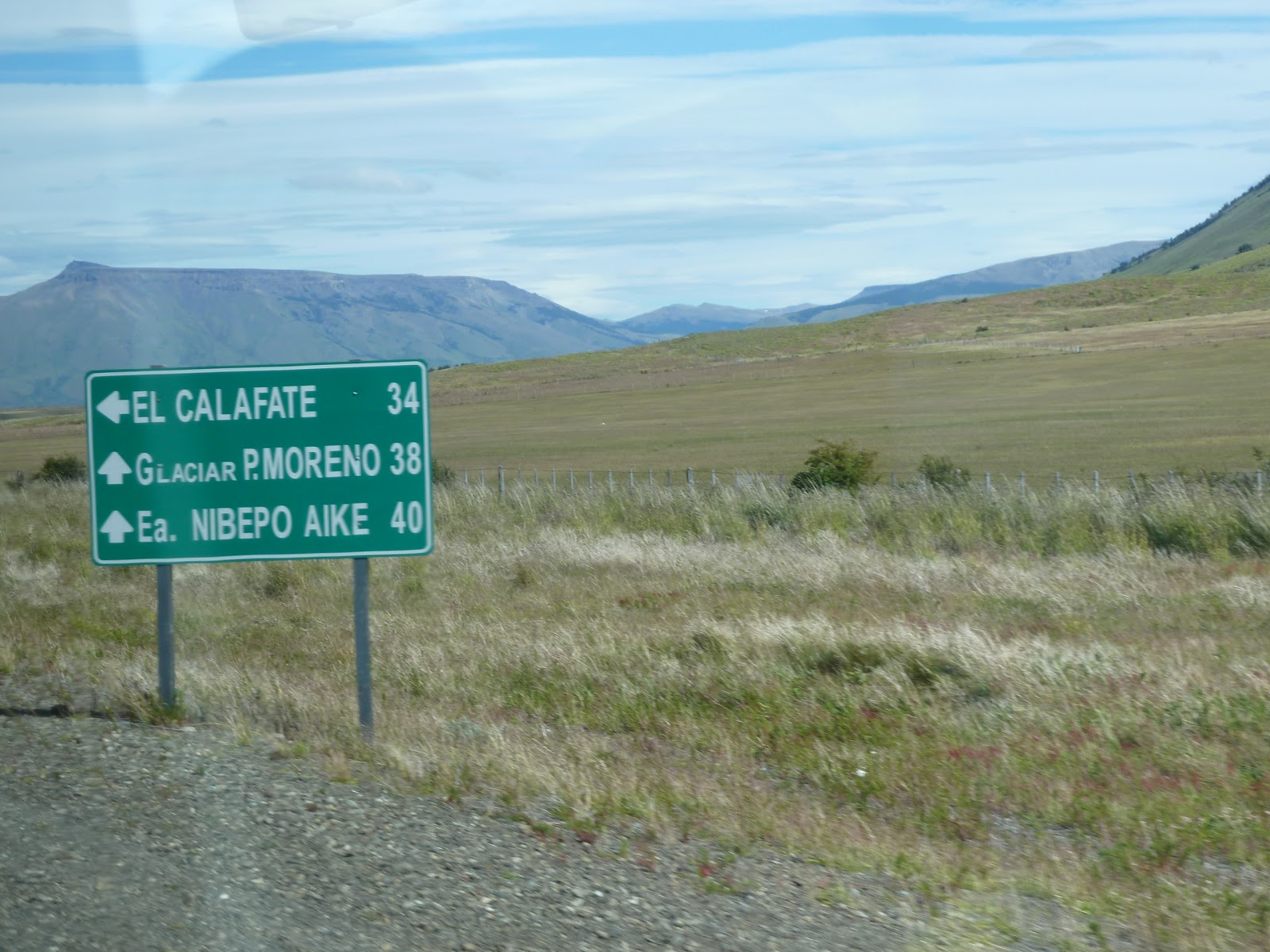
After observing the northern side of the Perito Moreno Glacier, we returned to El Calafate through the steppes. 
It is an all empty space and the views and the colours are beautiful. I hope this land will always stay this way. I hope that they won’t build a house, a hotel or a business in every single corner like in Turkey. I loved Argentina, this land –Patagonia- very much.
According to a legend, if you taste the ice cream, jam or juice of the fruit of the el calafate bush, which gave its name to this town, then you would come back here. So F. and I had el calafate ice cream. This way, for the first time in 7 months, I had ice cream just for the sake of this legend. It was quite nice. It is a dark purple fruit, which is in between a grape and mulberry.

The wind now seems to have stopped. I hope that we will not experience scary moments during our flight to Buenos Aires tomorrow.
All photos, Copyright Travelogueress

Friday, 5 August 2011

Argentina Part IV- Trekking on Glaciers


Date: 26 December 2010
Day: Sunday
Location: El Calafate
What made the Argentine Ernesto Guevara, Che Guevara and made him change the Latin American history was his motorcycle trip with his friend starting in Argentina. I wonder if our trips will one day cease to be selfish and serve a good purpose.

When we left El Calafate this morning to go to Perito Moreno Glacier, we first passed through Patagonia’s empty and yellow steps. From time to time, we saw horses and bulls roaming around freely. We also saw some estancias.
This part of Patagonia mostly had immigrants from England, Wales, Finland and Norway, so they are the owners of these lands and animals. The only country outside of Wales where Welsh is spoken is Argentina. The mid parts of the country mostly had immigrants from Spain and Italy.

Following the turquoise coloured Argentina Lake, we noticed that eventually the plants started become taller and finally formed a forest. As we got closer to the glacier, the colour of the water turned into milky water.

We reached closer to the glacier through a catamaran. 
After walking through the forest a little (it was unexpectedly warm), crampons were fitted to our shoes. 
The crampons were quite heavy and it wasn’t easy to get used to walking in them.
There are condors (South American vultures), woodpeckers and pumas in the forest through which we walked. We had the opportunity to see a condor flying near the summit of the mountain. They can be as wide as 3 m. Most important of all, we had the opportunity to climb and trek for two and half hours on the Perito Moreno Glacier.
The surface of this glacier is 300 square km. 
It is not a glacier on a mountain. It has been formed with the accumulation of heavy snow for years. It goes hundreds of meters deep under the lake and its height reaches 80 m. above the lake.
Its colour is neon blue in places due to the rays of light it captures from the sun and its density. 
It is magnificent and breathtaking. It was a fantastic experience to climb and trek on the glacier. Especially going down was complicated.

Our guide Leonardo is the Argentina ski champion and he even climbed the Everest. Even though our climb was not to Everest, it was still fantastic. After trekking on the glacier for two and half hours, a surprise was waiting for us hiding among the icy formations: a table with drink and chocolate on top and a couple of boxes. 
The guides break the ice here and offer the tourists natural water.
On the way back, when we took the crampons off, I felt as light as a bird, I could have flown. I noticed that my speed had accelerated during our walk in the forest on the way back even though I was very tired.
This forest is also very beautiful and nice smelling. The walk was actually relaxing.
The Argentine glaciers besides Perito Moreno recede every year 50 to 100 meters. It is a very serious situation. While we were trekking in the forest and on the catamaran, we witnessed a few times a big piece of ice breaking and falling in the water with splendour and noise. 
As now it is summer, this is normal but this does not change the facts about climate change and that the water levels are rising.

The speed of wind in El Calafate can reach 140 km at times. Today, it was at least 90 km. per hour. 
While we were trying to walk on the steppes to see the flamingos by the lake, it was impossible for us to keep both feet on the ground. 
The wind was pushing us to run. I would not want to be on air, in a plane today. With the intention of seeing flamingos, we also got to see very closely the ducks around them, the low flying geese and most beautiful of all the grazing horses who were roaming around freely.
 Right now, it is as if the wind is talking.
All photos & videos, Copyright Travelogueress