Sunday, 27 December 2009
Today was a very long and intense day. This is what happens when one tries to fit all Damascene history and monuments in one day. Of course it is impossible for me to write what the guide told us. I can only pass on my impressions about the city.
Damascus is the oldest inhabited city in the world. It is a total chaos. There is always a smell of smoke and coal in the air. The smell got on our cloths and hair. Old Damascus is something in between Sultanahmet and old Dhaka. Of course, it is not as crowded as Dhaka but even then it is disorderly.
Its history going back to pre-historic and Neolithic times have seen the Ancient Greeks, Romans, Byzantines, Arabs and Turks (400 years). Even though just like the Lebanese their past goes back to Phoenicians, they don't say that they are not Arabs like the Lebanese. The city is surrounded by mountains. Disorderly urbanism has left no beauty or green in the city.
After the big European powers provoked the Arabs against the Ottomans, the Saudi King Faisal was brought to the head of the lands consisting of today's Syria, Lebanon, Palestine and Jordan. But this was not long-lasting because King Faisal could be nothing but a puppet of the big powers. This united group of countries was called the Sham Countries and Damascus was its capital. The Syrian Arabic has Turkish words and expressions such as "metelik" and "duz para." The current head of state, Esad el-Bashir doesn't live in his palace. He lives among people, near the hills, in a flat in a rich neighbourhood.
He uses his palace for work as an office.
 |
Copyright Travelogueress
He has an open-door policy toward the public. His pictures are everywhere around the country but according to our guide, he does not like this; the public hang his pictures because they like him. |
Their national museum is incredibly rich. Even though they don't have many resources, I think it is the sort of museum, which can compete with the British Museum and the Louvre. They have the replicas of palaces from various civilisations and temples; it is very impressive. Right next to the museum, there is a mosque and caravanserai built by the Ottomans.
 |
| Copyright Travelogueress |
When one looks at these, one feels like in
Istanbul.
 |
| Copyright Travelogueress |
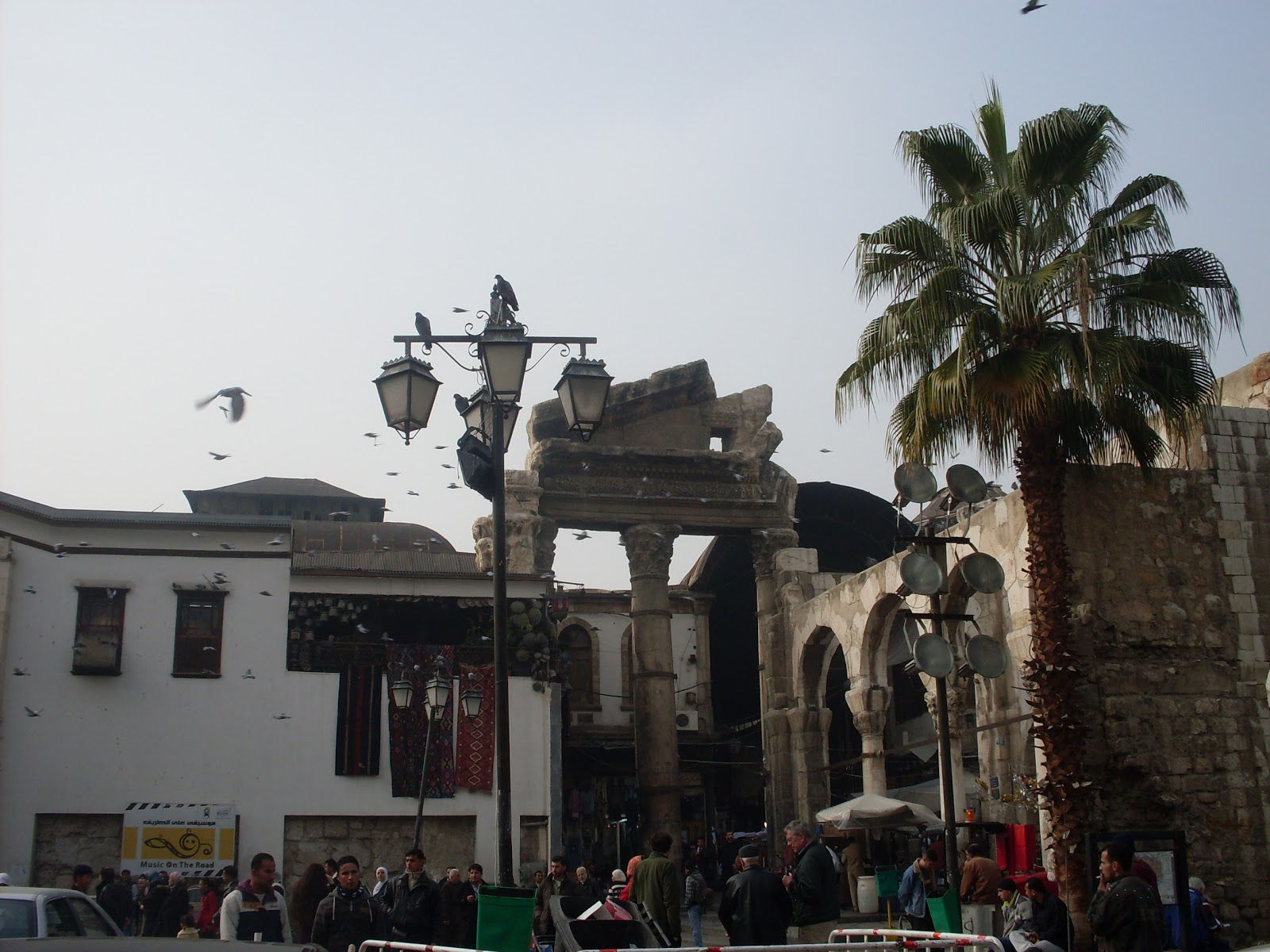
Among the other impressive buildings and places we have seen are the Al-Hamidiye Bazaar (built by Sultan Abdulhamit; its shops and what they sell reminds me of 1001 Nights stories), the Umayyid Mosque and the Azam Palace.
The Umayyid Mosque was a Jupiter temple in ancient times.
 |
| Copyright Travelogueress |
During ancient
Greece times it was a Zeus temple and during the civilisation before the Greeks, it was a Baal temple. So whoever took over adapted the previous god to its own and turned it into a new temple. The Romans'
Jupiter Temple was turned into a church by the Byzantine and into a mosque by the Muslims.
 |
| Copyright Travelogueress |
The golden mosaics are stunning.
 |
| Copyright Travelogueress |
Saint John's head is buried here.
The Azam Palace has been built by the Ottomans, the Ottoman Damascus Governor Asad al-Azem in the same style as the Topkapi Palace and has hareem, selamlik and courtyards similar to the palace in Lebanon. It is a nice palace. It is nicer than the one in Lebanon.
 |
| Copyright Travelogueress |
The orange and lemon trees in the courtyard are lovely.
 |
| Copyright Travelogueress |
The streets of old Damascus are so narrow that it feels like the buildings will collapse onto each other.
 |
| Copyright Travelogueress |
People can pass window to window easily, without having to jump. The streets are not dirty with trash but are very dusty. Air pollution is a big problem. The rivers, which surround the old city walls stink of drainage. Many buildings look like they are about to collapse.
 |
| Copyright Travelogueress |
As I wrote earlier, it is not a beautiful city but full of history. Because they lack resources of course they cannot restore the historical monuments. In those narrow streets as one enters through one of the small doors though, one finds oneself in a completely different world. The houses, which look small and narrow from the outside, are incredible large inside. Houses with large courtyards, if they belong to rich families, are decorated like a palace.
 |
| Copyright Travelogueress |
The traffic system, though not as bad as
Dhaka, is pretty bad.
 |
| Copyright Travelogueress |
If the population was as much as
Dhaka, it would be in the same state. Table manners and eating habits [...].
With every passing day, I start to think that by travelling every corner of
Turkey, one would be like having travelled all over the world with regards to history and nature. At least, to see the main civilisations and the history of the three big religions surrounding the
Mediterranean. Maybe I am getting old.
 |
Copyright Travelogueress
By the way, during this trip, I feel so much better psychologically. [...] I don't have questions scrutinising absolutely everything in my brain all the time. Somehow, I am either distanced from myself or because I am not following my daily routine, I am getting closer to my real self, I don't know. Anyway, I feel happy. Even though every morning when I wake up and during the day from time to time again [...] remember and think [...] I am more at peace with myself when I am far from my daily routine and am travelling. All photos, Copyright Travelogueress |